Blog
Bridging the Healthcare Gap: Why 2-Year Health Career Colleges Are Essential to Our Future
Below is an article written by Kenneth Feldman, Ed.D, our new Director of Education here at Swedish Institute. It’s an insightful piece all about what makes modern healthcare education at a school like Swedish Institute so important.
Welcome aboard, Dr. Feldman, and thank you for such a great article!
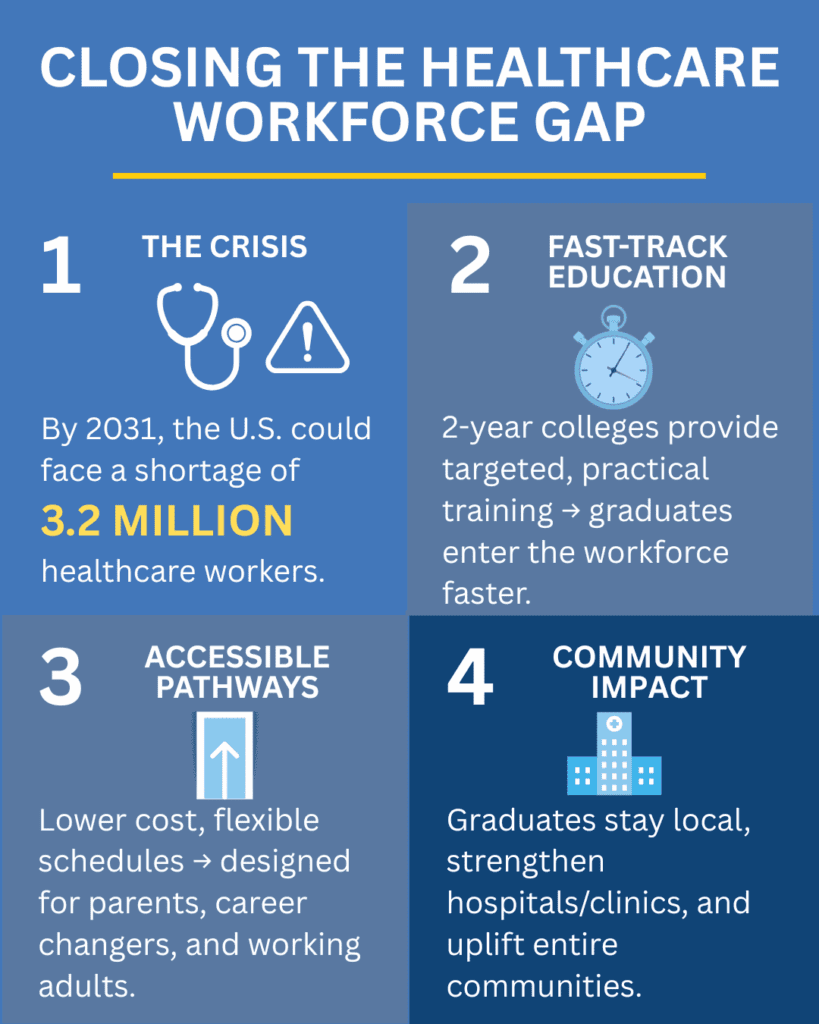
By 2031, the U.S. is projected to face a shortage of up to 3.2 million healthcare workers. While the number is staggering, it also represents an opportunity—one that two-year health career colleges are uniquely equipped to meet.
Fast-Track, Focused Education
Unlike traditional four-year programs, two-year colleges provide practical, targeted training that leads directly to employment. Programs such as Nursing, Massage Therapy, Surgical Technology, Medical Assisting, Central Sterile Processing, Sonography, and Healthcare Administration prepare graduates to step immediately into critical roles.
Their true strength lies in agility. When the pandemic exposed urgent shortages, two-year institutions pivoted quickly, expanding high-demand programs—something larger, more bureaucratic institutions often struggle to do.

Meeting Students Where They Are
Today’s students aren’t just recent high school graduates. They’re career changers, parents reentering the workforce, and professionals seeking advancement. Two-year colleges address these realities with flexible schedules, evening and hybrid options, and accelerated pathways.
Two-year colleges also have lower barriers to entry. With shorter timelines and more affordable tuition, these programs provide access to stable, well-paying healthcare careers that might otherwise feel out of reach. For many graduates, the return on investment is immediate: higher salaries and job security in a resilient industry.
Partnerships That Deliver
The best programs don’t operate in a vacuum. Strong partnerships with hospitals, clinics, and healthcare systems ensure curricula match real-world needs. Students gain hands-on experience through clinical rotations, externships, and mentorships—often leading to job offers before graduation. It’s a direct pipeline from classroom to career, benefiting both students and employers.
Strengthening Communities
Investing in two-year health career colleges creates a ripple effect. Graduates often remain in their communities, becoming the backbone of local hospitals, clinics, and practices. Many also pursue further education, carrying forward their practical experience into bachelor’s and master’s programs—elevating the entire healthcare ecosystem.
A Call to Action
As our population ages and healthcare needs evolve, we cannot overlook the essential role of two-year health career colleges. These institutions deserve support through funding, partnerships, and recognition of their contributions to workforce development.
The question is not whether we can afford to support these programs. It’s whether we can afford not to.
Recent Posts
- Bridging the Healthcare Gap: Why 2-Year Health Career Colleges Are Essential to Our Future
- Swedish Institute Awarded on USA TODAY’s America’s Top Vocational Schools 2025 List
- An Inside Look at Medical Assistant Classes
- Why are Sepsis and Staph Infections So Common in Hospitals?
- Mental Health, Nursing, and Education: Meet Swedish Institute Grad Omarr Savage